

In our previous post, we introduced learning domains and why they matter in course design. As you plan a course, one useful question is how many distinct skill areas students need to develop. This guide explains several options and how to choose among them.
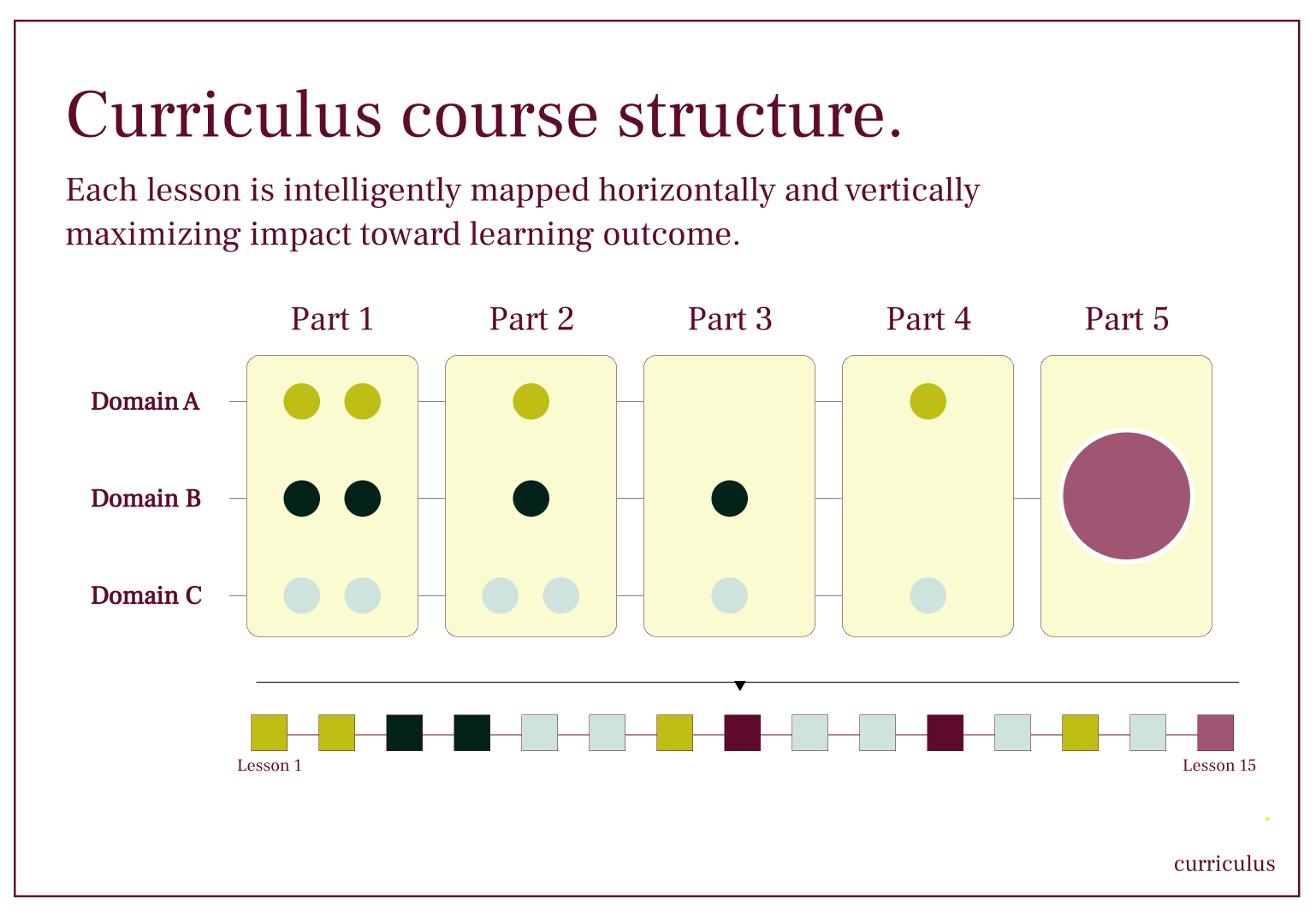
Single Domain: Two Different Approaches
If you pick one domain, your teaching will focus on building skills in that area. There are two main ways to approach this.
Broad Coverage (Option 1a): Choose this if students need to see the big picture before specializing, or if you want them to make informed choices about what to study next.
This approach is like exploring a whole continent at a steady pace. Learners visit many areas, see how they connect, and get a sense of the bigger picture. They don’t become experts in one area, but they develop "continental literacy"—the ability to move around and understand how different parts fit together.
This works best if your main goal is to give students an overview and help them get oriented. If your course introduces a field, explains its scope, and helps students find their interests, broad single-domain coverage is a good choice. Students will understand the context well, though they won’t develop deep expertise.
With broad coverage, students usually begin with several foundational skills in Part 1 (often three), explore different combinations in Part 2, and reach a key insight in Part 3 that connects the main parts of the field. This helps them become versatile and see how everything fits together.
For broad coverage, plan lessons that introduce the foundations, give students practice connecting them, and help them understand the field as a whole.
Focused Proficiency (Option 1b): Choose this if students need to show they can use a specific method well, and deep skill in that area matters more than knowing about other options.
This is like getting to know one city really well instead of traveling across a continent. Learners become familiar with the neighborhoods, understand how things work locally, and build the skills to handle complex situations in that area. They see fewer places but become highly skilled in one.
This approach is best when you want students to show real skill. It works well for professional training, certification, or any situation where learners need to perform well in a specific method. The result is strong proficiency in a clear approach. With focused proficiency, students start with fewer basics and spend more time going deeper.
For focused proficiency, develop a few foundations more deeply, add practice of increasing complexity, and assess the specific capability you want students to demonstrate.
Deciding Between 1a and 1b
The key question is: At the end of this course, do students need to understand the overall field, or do they need to perform well in a specific skill?
- If graduates should navigate broadly and choose where to specialize, choose 1a.
- If graduates should perform competently using a specific approach, choose 1b.
Two Domains: Comparative Understanding
When you choose two domains, you set up a structure where students build skills in each area, then learn to compare, contrast, and combine the perspectives.
This is like learning to drive both in city streets and on highways. Both are driving, but each needs different skills and judgment. City driving involves things like watching for pedestrians and parking in tight spots, while highway driving means paying attention over long distances and merging into fast traffic. If you only know one, you’ll struggle with the other. Good drivers need both and must know when to use each set of skills.
A two-domain course helps students understand each approach and how they differ. Being able to compare is often more useful than deep expertise in just one, since real situations rarely fit only one method.
So let’s take a real course that we’ve worked on: Game Theory. This course naturally flows across two learning domains: classical strategic analysis and behavioral decision-making. Classical game theory teaches Nash equilibrium, strategic calculation, and what rational actors "should" do given their incentives. Behavioral game theory teaches how people actually decide, including psychological factors, cognitive biases, and bounded rationality. Students who develop both gain meta-awareness about when rational models predict well and when behavioral factors dominate, which assumptions hold in which contexts, and why the same situation can look different through each lens.
In practice, each domain has its own basics, combinations, and key insights. Later, students bring both together, practicing applying each perspective to the same problem and choosing the best approach for each situation.
For a two-domain course, plan exercises and assessments that ask students to use both perspectives and decide when each applies.
Choose two domains if your field includes truly different perspectives that practitioners need to use at the same time, and the value comes from knowing when and how to use each.
Recognizing "False Two"
Sometimes, what looks like two domains is really one domain with subcategories or different viewpoints. If both share the same main ideas and lead to similar results, you probably have one domain with some variety. In that case, broad single-domain coverage (1a) is usually better.
Two domains should give you genuinely different ways to understand the same topic. If combining them leads to new insights or useful differences, you likely have a true two-domain setup.
Three Domains: Multiple Competencies
Choosing three domains means your field requires three distinct skill areas that can’t be folded into one or two. This is the most complex option and takes careful planning, but it gives students the widest set of connected abilities.
This is like training for a triathlon instead of a single sport. Swimming, cycling, and running each need specific skills, techniques, and conditioning. Triathlon athletes must manage transitions, balance training across all three, and decide how to use their energy throughout the event.
Three-domain courses help students become competent in each area and learn to manage their interactions. Part 5 is especially important, as students practice using all three skills together.
With three domains, students also need to practice many combinations in Part 2. If there’s one basic skill per domain, there are already three pairs to work with:
- Domain A with Domain B
- Domain B with Domain C
- Domain A with Domain C
If each domain has two basic skills, there are more combinations to consider. That is a reason to check whether the course gives students enough practice before asking them to integrate the domains.
Choose three domains if your field truly needs students to combine several different skill areas in practice. For example, healthcare education often requires clinical skills, communication, and system navigation.
Avoiding "False Three"
The risk with three domains is adding more content instead of more real skills. If you add a third domain just because you have material, not because practice needs it, students may end up with scattered learning.
Ask yourself: If I had to use only two domains, would I lose something essential?
If the answer is no, you probably have two domains and some extra content that fits within them.
Decision Framework
Use this as a quick reference when choosing your course setup.
Start by asking: What should someone who finishes this course be able to do in the real world?
- If the answer emphasizes understanding a field's scope and making informed choices about specialization → Single domain, broad coverage (1a)
- Academic example: Introduction to Psychology, Survey of Data Science Methods, Foundations of Marketing. Students leave knowing the landscape and where they might want to go deeper.
- Corporate example: New manager orientation covering HR policies, budgeting basics, and team communication. Managers leave understanding organizational systems before diving deep into their specific department's processes.
- If the answer emphasizes demonstrable capability in a specific approach → Single domain, focused proficiency (1b)
- Academic example: CPR certification, a Python programming bootcamp, and Cognitive Behavioral Therapy training. Students leave able to perform a specific skill competently.
- Corporate example: Salesforce administrator certification, compliance training, or a specific sales methodology like SPIN Selling. Employees leave able to execute a defined process correctly.
- If the answer emphasizes comparing perspectives and knowing when each applies → Two domains
- Academic example: Research Methods (quantitative and qualitative), Economics (micro and macro), and the game theory course described above. Students leave holding multiple lenses and knowing when to use each.
- Corporate example: Customer success training combining technical product knowledge with consultative communication skills. Representatives leave knowing both what the product can do and how to uncover what customers actually need.
- If the answer emphasizes integrating multiple distinct competencies in professional practice → Three domains
- Academic example: Accounting programs preparing for CPA licensure (technical accounting, audit methodology, regulatory compliance), teacher certification (content knowledge, pedagogy, classroom management). Students leave able to combine genuinely different capabilities in real situations, often with legal or licensing requirements governing each domain.
- Corporate example: Leadership development programs combining strategic planning, people management, and operational execution. Leaders leave able to set direction, develop their teams, and deliver results simultaneously.
- Academic example: Accounting programs preparing for CPA licensure (technical accounting, audit methodology, regulatory compliance), teacher certification (content knowledge, pedagogy, classroom management). Students leave able to combine genuinely different capabilities in real situations, often with legal or licensing requirements governing each domain.
Then check the following:
- For two domains: Are these genuinely different ways of understanding, or one approach with internal variations?
- For three domains: If forced into two domains, would something essential be lost?
- For any setup: Is this manageable for students? Can they realistically learn and keep track of this many domains in the time you have?
What Each Option Produces
Remember, no option is automatically better than the others. The best choice depends on what your students need to learn and how much time you have. Each option leads to a different kind of course outcome:
- Single domain (broad): Graduates who understand a field's landscape can move across its main areas and make informed decisions about where to specialize.
- Single domain (focused): Graduates who can perform competently using a specific methodology, with depth that comes from concentrated development.
- Two domains: Graduates who hold multiple perspectives at once, understand when each applies, and select approaches based on context.
- Three domains: Graduates who can operate across multiple competency areas and integrate them in real practice.
What Curriculus Does For You
A skilled instructor or course designer can do all of this manually. Deciding on domains, combinations, integration points, and balance is something experienced educators already consider. The time-consuming part is tracking all the relationships, making sure the right combinations are in your lessons, checking that integration exercises are in the right places, and updating everything when you make changes.
You confirm the learning areas, goals and sequence. We develop the course plan and lesson drafts from your direction and readings. You review how the learning areas connect and identify the changes you want.
About Curriculus
Curriculus develops course plans and detailed lesson guides with instructors. We connect your readings to explanations, discussion and practice, then revise the drafts with your feedback. See how we work together.