

You’re probably familiar with backward design. Maybe you’ve even used it to build courses, starting with the end goal and working backwards to create assessments and learning experiences that fit. Wiggins and McTighe's framework was introduced in Understanding by Design in 1998. It’s effective, and like any good framework, it keeps evolving.
We saw an opportunity to add detail to that framework. We call the approach Outside-In: start with the intended abilities, identify the moments when students need to connect theory with practice, and plan the foundations and applications around them.
The GPS Problem
Think back to your last big road trip. You picked your destination first and then planned backwards. That makes sense. But if you only draw a straight line on the map, you miss the pit stops, refueling spots, and landmarks that help you know you’re still on track.
A course outline can stop at this level of detail. It names where students start, where they should end up and the weekly topics, without yet explaining the connections between them. It’s like using a GPS that only shows your current location and your destination, with everything in between blurred out. Students need more than that. They should see the key moments along the way that truly change how they think.
Breakthrough Moments: The Missing Waypoints
The idea of "waypoints" is already well known. Research on threshold concepts shows that students should experience shifts in understanding that change how they see the subject. These are the portals that open up "a new and previously inaccessible way of thinking about something." As a quick aside: anyone who took Physics and had Physics Day at Six Flags knows exactly what a breakthrough application feels like. That was the moment physics stopped being abstract formulas and became real, fun, and enchanting. Every academic domain has this opportunity.
Here are examples of shifts in understanding across different domains:
Technical and scientific domains: Breakthroughs in system understanding. This is the moment a student realizes statistics is a decision-making framework vs a “different type of math”. Suddenly, p-values become tools for navigating uncertainty.
Creative and artistic domains: Perspective shift breakthroughs. This is when a student understands that composition rules exist to be purposefully broken. The grid becomes a launching pad.
Physical and somatic domains: Mind-body connection breakthroughs. This is the moment when breathing shifts from automatic to intentional. Performance changes when students realize their breath controls their nervous system.
Social and interpersonal domains: Relational awareness breakthroughs. This is the moment when conflict stops being seen as failure and becomes data. Disagreement changes from something to avoid into information to explore.
If you leave out these breakthrough moments when designing a course, it’s like planning a cross-country trip and forgetting about the Rocky Mountains. You need to consider how the challenges and peaks of crossing the Rockies add to your road trip. Breakthrough moments are important. They connect where students begin to where they need to go.
How Outside-In Adds Detail to Backward Design
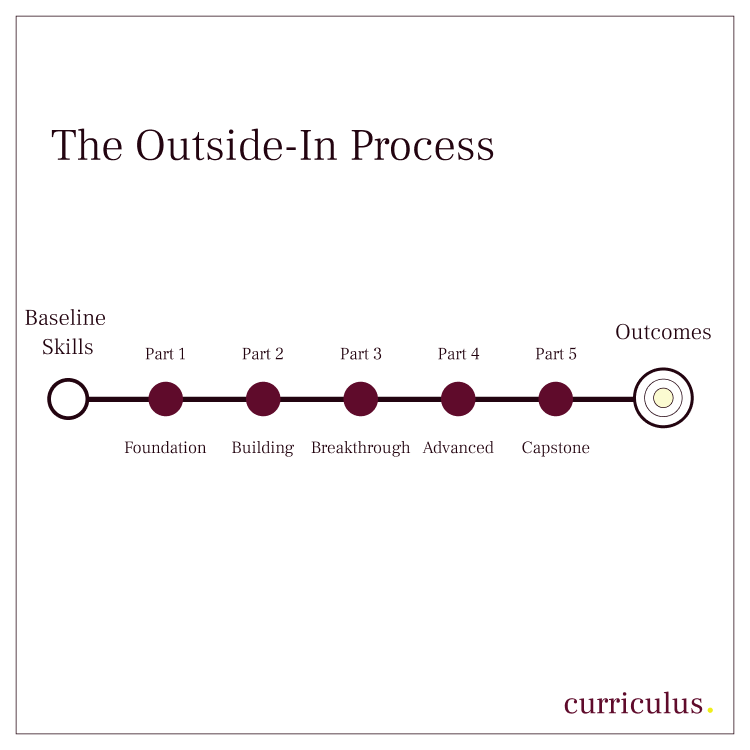
Outside-In builds on backward design by identifying important shifts in understanding and planning the lessons around them. You still begin with the outcomes, but you also ask where theory needs to become useful in practice. Then you plan the preparation and applications that support those moments.
Here's the gist of it:
Parts 1 and 2 set the foundation. What do students need to master before they can have a breakthrough? These are the basic vocabulary and concepts that make change possible. If there are two foundational skills, Part 2 brings them together. With three, you mix and match the pairs. Students need to see these connections before big breakthroughs happen.
Part 3 is about those aha moments. Here, students move from theory to understanding and then to application. The connections become clear. These lessons use real-world examples and field observations to show why the theory matters and where it may not work.
Part 4 puts the breakthrough to work. Students take what they learned in Part 3 and apply it to new situations. This is when they see that their new understanding truly changes how they view things.
Part 5 brings everything together. All the domains, breakthroughs, and applications combine into one complete skill set.
What Changes When You Design This Way
Outside-In makes the intended shifts in understanding explicit alongside the outcomes, assessments and learning activities. In planning a course, ask which connections students need to make and how they will practice applying them.
Sequencing takes careful work: choosing the order of topics, considering what students need to know first, and planning how the practice becomes more demanding. The same care belongs in the moments when students connect ideas and put them to use.
You don’t need to throw out your current curriculum to try this approach. Start with one course, find one breakthrough, and build one thoughtful connection.
Think about your hardest course. Where do students usually get stuck? It’s probably just before a breakthrough you haven’t identified yet. What change in thinking would help them move forward? What could you add to help them reach it?
About Curriculus
Curriculus develops course plans and detailed lesson guides around the direction and readings you confirm. You review the academic choices and guide revisions. See how we work together.